The cost of Local Law 18: new data shows NYC homeowners lose $110 million
Key Takeaways
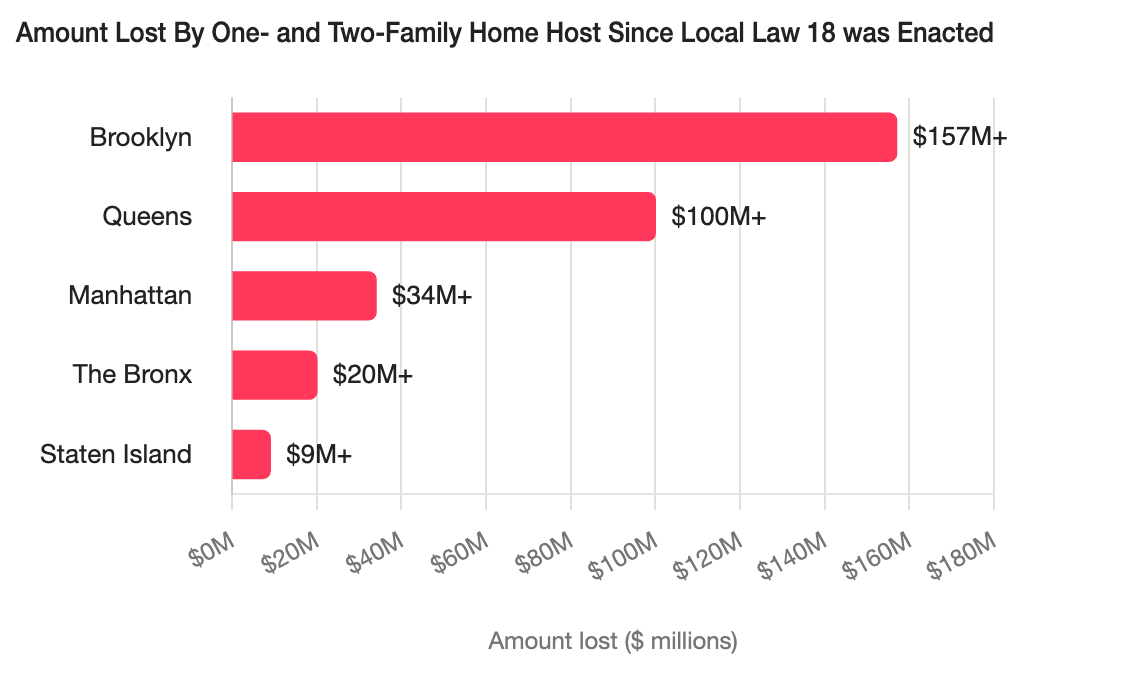
- Three years of restrictive short-term rental regulations have cost New York City one- and two-family homeowners more than $320M in lost short-term rental income—money that could have gone towards mortgages, caregiving, and staying afloat in the country’s most unaffordable city.
- Typical outer borough homeowner earnings fell by $15,500 after Local Law 18 took effect. For many, this income loss compounds affordability pressures, causing homeowners to leave the city—a trend reaching record highs among Black New Yorkers.
- Updates to the law, spearheaded by outer borough homeowners and community leaders, aim to fix what Local Law 18 broke: the ability to manage rising property taxes and costs, and to stave off predatory practices like deed theft.
In the fall of 2018, as New York City ramped up its battle against short-term rental hosts in the name of increasing housing and lowering rents, Mariana G. was weathering a divorce and came close to losing her home. But as she describes it, her first bookings through Airbnb allowed her to pay the mortgage of the Pelham Gardens home where she was raising her children. The modest short-term rental income she was earning allowed her to take care of her aging father, who had moved in with her after Hurricane Maria had pummeled Puerto Rico. Today, three years after the city enacted the country’s most restrictive rules against short-term renting, Mariana estimates she has lost roughly 45 percent of the income that had gotten her through so much. She may once again be one disaster from foreclosure.
Like Mariana, many New York homeowners are grappling with the loss of income and the unintended consequences of Local Law 18. Meant to fix NYC’s housing crisis, Local Law 18 has failed. Instead, since September 2023, NYC homeowners in one- and two-family homes have lost approximately $110 million a year in short-term rental income, according to a new internal analysis. Typical host earnings in those homes have fallen by $15,500 annually, depriving homeowners of a critical economic lifeline.
"It was really an emergency. Had I been late to that first payment, my house was gonna go right back to foreclosure. My Airbnb reservations allowed me to more or less see what my month would look like. And ever since, that became my crutch, my leg to stand on so that I could make these payments," said Mariana Gonzalez, Airbnb host from the Bronx.
Another homeowner, Tonya C., did get Office of Special Enforcement (OSE) approval to rent out part of her Bed Stuy home, which her family has owned since the 1980s. However, she lives in fear of OSE arbitrarily deciding that she has violated one of their draconian rules and losing the income that she depends on. This loss would price her out of the neighborhood that her family has lived in since her great-grandmother immigrated to Brooklyn over a century ago.
Instead of staying in the Bronx, Brooklyn and Queens, and Staten Island, where Airbnb listings plummeted by over 90 percent after the law’s implementation, travelers are now pushed into corporate Midtown hotels or to New Jersey. Visitor spending happens strictly in Manhattan and out-of-state rather than contributing towards New Yorkers’ mortgages and bills, exacerbating the housing crisis impacting New York’s homeowners across the five boroughs.

Three years in, a coalition of housing, civil rights, and community organizations has joined local homeowners in calling for updates that would correct the consequences of Local Law 18. Introduced by Council Members from the outer boroughs, Intro. 879 would let homeowners share their homes with up to four guests instead of just two, lock their bedrooms, closets, or offices, and host while traveling for work or when a big event is in town—all while making no impact on New York City’s long-term housing supply and preserving the rest of the law, including the primary residence requirement.
Independent data confirms Local Law 18 falls short of promised increased housing and lower rents—but rents continue to surge, vacancies remain flat:
- Citywide rents have climbed to $3,730, a 14.8% increase since 2023, according to StreetEasy’s Rent Index.
- Despite a 92 %decrease in short-term rentals in NYC after LL18, the rental vacancy rate stands at 3.3 percent in August according to Apartment List, virtually unchanged from three years earlier.
- Hotel costs continue to reach record highs, up 21% in the last three years—triple the increase nationally.
“Local Law 18 has failed to increase housing and lower rents as promised, instead costing NYC homeowners $15,500 annually. We agree with Council Members and communities advocating for reform that would restore this critical lifeline without affecting the rental market,” said Nathan Rotman, Airbnb Director for North America Public Policy Strategy.